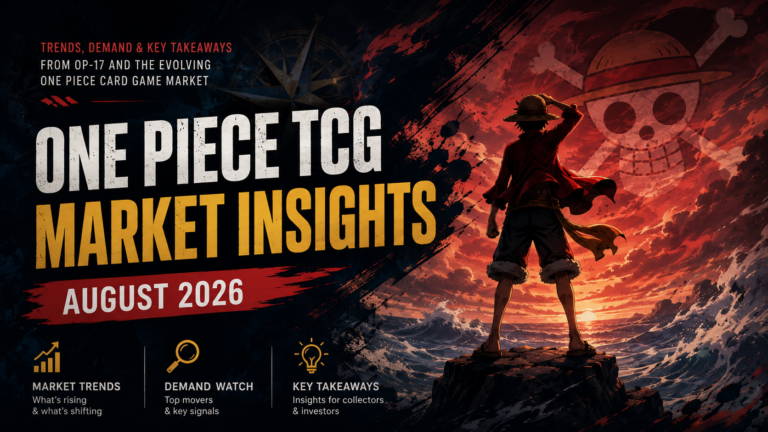

The One Piece Card Game market has been going through a period of adjustment this August.
After months of strong attention across new releases and sought-after singles, some parts of the market have started to soften. The movement isn’t uniform, but enough cards and releases have shifted to make this an interesting point for collectors who have been waiting on certain purchases.
Rather than chasing the market at its highs, this can be a useful time to step back and look again at the cards and sets you’ve wanted to collect
A correction is taking shape across parts of the market
Recent market data shows that some One Piece TCG singles have been moving lower as supply increases and the initial excitement around newer releases begins to settle. OP-16, for example, experienced a notable decline across its tracked singles during the weeks following release.
This kind of movement is a normal part of the life cycle of a trading card release.
A new set typically moves through a period of anticipation, launch excitement and heavy initial demand. As more product is opened and more copies become available, the market begins to find a new balance.
That process can create opportunities for collectors who were willing to wait.
Not every card is moving in the same direction
One of the most important things to understand about the current market is that there isn’t a single direction across every set.
Some releases and individual cards have softened, while others continue to show stronger demand. Current market tracking reflects that split, with some mature sets continuing to perform well even as other segments weaken.
That makes the current environment very different from a broad market decline.
The better way to describe it is repricing.
Collectors are becoming more selective about what they want to own, while cards that were heavily supported by release excitement have more room to settle.
Older releases deserve another look
One area we’re particularly interested in right now is the older part of the One Piece TCG card pool.
As attention moves toward newer releases, some earlier sets can become easier for collectors to revisit.
This doesn’t mean every older card is suddenly undervalued.
It simply creates a wider range of choices.
Sets such as OP-07, OP-09, OP-10, OP-11, OP-13 and OP-14 continue to offer a broad mix of characters, alternate-art cards and collector-focused printings, while more recent releases such as OP-15 and OP-16 are now entering cooldown stages of their own market cycles.
For collectors looking to revisit sealed releases, our One Piece TCG Booster Boxes collection covers a range of Japanese sets currently available at DojoTCG.
Singles can be even more interesting
A correction doesn’t make every card a good purchase. What it does is create more room to compare different versions of the cards you already want.
Character demand is also worth watching. Luffy continues to attract exceptionally strong collector interest, while Sanji remains one of the more established collector characters in the card pool. Recent market movement shows that even popular characters can go through periods of correction, which can create more accessible entry points for collectors who already have them on their wishlist.
For collectors who have been waiting on a Luffy or Sanji card, this can therefore be a good time to revisit those cards and compare the different printings, rarities and treatments available.
You can explore our Luffy cards and Sanji cards, alongside our wider One Piece TCG Singles collection.
We’ve adjusted our prices with the market
We’ve been watching these changes closely at DojoTCG and have also revisited our own pricing across a number of cards and products.
Where the market has softened, we’ve adjusted our prices accordingly.
That means collectors who may have looked at certain cards earlier in the year and decided to wait may now find a more accessible entry point.
We’ve made adjustments across different parts of our One Piece TCG selection rather than focusing on one particular release, because the movement we’re seeing isn’t limited to a single set or rarity.
You can browse the current selection of One Piece cards available at DojoTCG and see where prices have been updated.
What makes a correction worth paying attention to
A lower price by itself isn’t necessarily meaningful.
What matters is the relationship between collector appeal and current accessibility.
A card with strong artwork, a popular character, a distinctive treatment or a place in an important set can remain appealing even after the broader market moves lower.
This is where corrections can become useful.
They give collectors an opportunity to revisit cards based on what they actually want to collect, rather than simply following whatever is attracting the most attention that week.
We’re watching what happens next
The next stage of this market will depend on how much additional supply enters circulation, how collectors respond to newer releases and which cards continue to attract attention after the initial excitement fades.
OP-17 is likely to be an important part of that picture. Its Japanese release on August 22 introduced another major wave of premium treatments into the market.